


Artificial Intelligence (AI) is reshaping industries worldwide, and agriculture is no exception. In Albania, this transformation is being led by high school students who are learning to connect technology with sustainability and create meaningful solutions for their communities.
Through the EIT Food DTTI (Digital Transformation for Training and Innovation) Action in Food programme, implemented by Junior Achievement of Albania (JA Albania), students and teachers from across the country explored how AI can support smarter, more efficient, and environmentally responsible agricultural practices.
From Classrooms to Innovation Labs
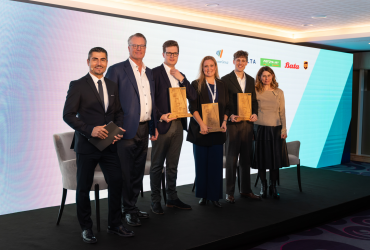
Over recent months, 13 high schools across Albania became hubs of creativity and experimentation. Guided by 13 trained teachers and supported by expert mentors, 433 students engaged in a learning experience that blended entrepreneurship, digital literacy, and applied innovation. They identified real challenges in agriculture — such as water scarcity and soil degradation — and designed 61 AI-based startup ideas to address them. What began as classroom discussions evolved into a national showcase of student innovation presented in a pitching event.
“We wanted students not only to learn about artificial intelligence but to use it as a tool to solve real problems,” said Ines Troqe, Project Coordinator at JA Albania.
Teachers as Catalysts of Digital Change
Behind this wave of creativity stood a dedicated group of teachers trained through DTTI, who adopted international practices for integrating AI and entrepreneurship education. The training combined practical digital tools with active learning methods, strengthening teachers’ confidence and ability to guide students toward inquiry-based learning.
Survey results confirmed the programme’s strong pedagogical impact:
- 100% of teachers reported increased knowledge of AI and entrepreneurship tools.
- 92% agreed the programme introduced international best practices and relevant case studies.
- 92% felt prepared to mentor colleagues and share their experience.
This multiplier effect ensures that the digital transformation in education continues beyond the project phase, as teachers transfer new skills to peers and classrooms nationwide.
A Spectrum of Student-Led Innovations
The 61 startup ideas proposed by students reflected diverse ways on how AI could be applied in agriculture — from high-tech precision tools to concepts suited for low-resource settings. Ideas covered areas such as monitoring and data collection, irrigation management, sustainable farming, automation and robotics, vertical cultivation, and educational platforms. While these ideas remained at the conceptual stage, they demonstrated students’ understanding of how digital tools can improve decision-making, optimize resources, and promote sustainability in agriculture.
One of the student teams, AquaBrain, presented HydroSense, a concept that stood out for its practical and environmentally friendly approach to water management. By combining artificial intelligence (AI), sensors, and solar panels, HydroSense offers an innovative and sustainable solution for households and areas with limited water access. The system is designed to optimize water use by automatically turning the water pump on and off based on soil moisture levels. Powered by solar energy, HydroSense provides a green, low-cost alternative that promotes efficient resource use and supports sustainable living in both rural and urban environments.
Learning Beyond Technology
Beyond the technical side, the DTTI Action in Food experience strengthened students’ entrepreneurial mindset, teamwork, and creativity. Many schools reported gender-balanced participation, and mixed teams often produced the most thoughtful solutions, highlighting how diversity enhances learning. For many students, especially from rural areas, pitching their ideas publicly was their first exposure to real-world innovation.
Building the Foundation for Future Careers
The outcomes of the DTTI Action in Food extend beyond the classroom, laying the foundation for a generation of young professionals ready to apply AI, data analysis, and sustainability thinking to one of Albania’s most vital economic sectors. By engaging teachers as multipliers and students as innovators, the programme illustrates how education can directly support national priorities in digital transformation and green growth.
“The ideas we saw represent more than projects,” noted a JA Albania representative. “They reflect a change in perspective — students now see agriculture as a field where science, creativity, and sustainability come together.”
A Future Rooted in Knowledge and Innovation
From AI-assisted irrigation to data-driven monitoring concepts, Albanian students have shown that the future of agriculture is intelligent, informed, and sustainable. With continued support from EIT Food, Intel, and the JA network in Europe, JA Albania remains committed to equipping both teachers and students with the tools and mindsets to shape this future — one that values innovation, responsibility, and collaboration.
Looking ahead, the next cohort of students is expected to bring forward new ideas and fresh perspectives to further strengthen this growing culture of innovation in Albanian schools.