


“Artificial intelligence doesn’t belong in schools.” That was the opinion of more than 80% of Czech teachers just two years ago. Today, the situation has reversed. It is now widely understood that education for the current generation cannot move forward without AI tools. But the key question remains: how to do it?
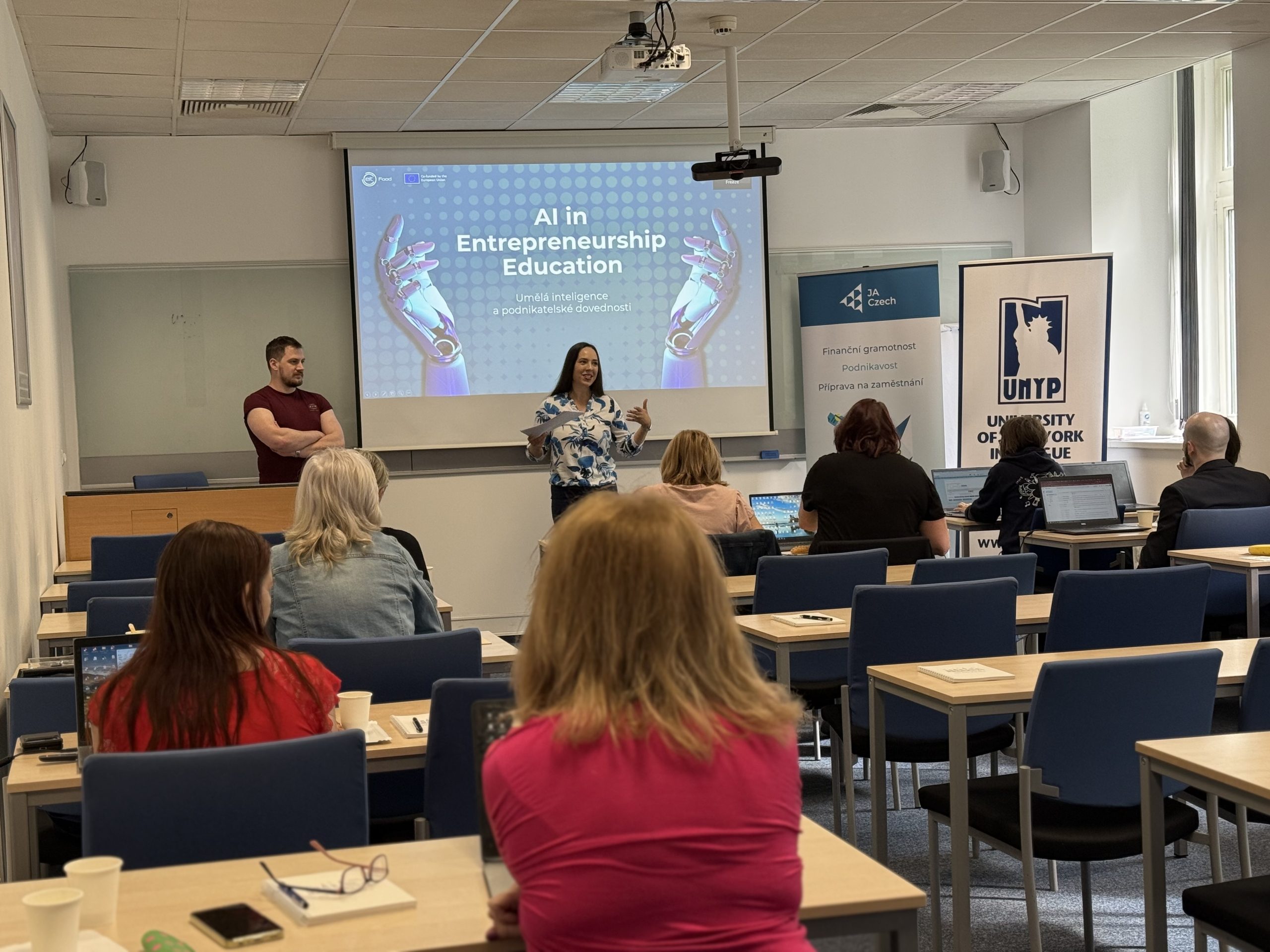
This is exactly the challenge addressed by the European project DTTI Action in Food, funded by the European Institute of Innovation and Technology (EIT Food), and implemented in the Czech Republic by the educational organization Junior Achievement under the name “AI in Entrepreneurship Education.”
The programme provides teachers with professional training, free of charge, to develop students’ digital literacy and entrepreneurial skills. “The impact of AI on the world around us can no longer be ignored, and schools must find effective ways to integrate AI tools into their teaching. For many educators, however, AI is still not intuitive or accessible – they don’t feel confident implementing it into lessons. Around half of all teachers still express concerns about AI because they either don’t feel technologically competent or see AI as unrelated to their subject area. Fortunately, schools and teachers now have access to development programmes that help them overcome these barriers – through interactive training, e-learning resources, and the sharing of best practices,” said Gabriela Káninská Repková, Senior Project Manager at the Czech office of Junior Achievement (JA Czech).
The professional training aims to show teachers the fundamental principles behind AI and how it can be used to help students face real-world challenges and opportunities that await them in the future. “Today’s teenagers cannot succeed in future workplaces without digital skills. While automation makes physical labour easier, AI facilitates mental work. In education, it should not be seen as a threat, but rather as a tool to foster creativity and critical thinking. The AI in Entrepreneurship Education programme was developed to support teachers in developing these crucial skills in their students. Teachers first go through intensive AI-focused training and then guide students in creating their own AI-based projects,” explained Martin Smrž, Director of JA Czech.
Six in-person and online training sessions have already been completed, attended by the first group of active teachers. In the past two semesters, nearly 200 secondary school teachers have used e-learning materials focused on AI. “We are seeing huge interest from teachers in how to use AI effectively in education. Our full-day training sessions have now been completed by 82 teachers from 53 schools – but the goal is to reach every secondary school in the Czech Republic. Unfortunately, rigid school curricula (ŠVP), limited lesson time, and budget constraints still hinder faster adoption. And yet, AI is no longer just a topic for ICT classes. We train teachers from all subject areas – languages, economics, psychology, history, even chemistry and biology – on how to meaningfully guide students in using AI tools across the curriculum,” Smrž added.
Teachers particularly praised the training for introducing them to new concepts in machine learning and data analysis, as well as for its practical exercises using AI tools. “I learned new ways to use AI in the classroom and had the chance to try out specific accessible tools, with a strong focus on data input – which is very useful for subjects like economics, marketing, and business management. I also appreciated learning from the experiences of other participants,” said Bohumíra Benešová, a teacher at the Secondary School of Informatics, Postal Services and Finance in Brno. “The training was a huge benefit and truly motivating for further work. I knew very little before, but the trainer was extremely patient and explained everything clearly. Now I just need time to think through how to apply all the new ideas in subjects like social science, biology, and health education,” added Jarmila Jánská from a Secondary School in Havířov.
Some teachers want to use AI to detect the originality of student work, analyze submitted essays, create teaching materials, or generate tests. Others are already guiding students in creating their own AI projects, for example as part of final assignments or year-long coursework.
“The training is hands-on and filled with real-life examples of how to use AI. For example, we explore computer vision using Google’s Teachable Machine, where participants train a model to recognise image content. Another session uses Microsoft Copilot for text analysis and structured output creation, including integration with Google Scholar. Teachers welcome all of this. The course is very intensive, and thematic modules in the available e-learning help teachers solidify their skills and bring them into student development during lessons,” explained Gabriela Káninská Repková.
A significant part of the training also covers ethical aspects of AI and entrepreneurial competencies, empowering students to turn ideas into action.
“Our task is to inspire teachers to make a change. Trained teachers can guide students in competitive programmes where they can try out how technology can be used to solve real-world problems—such as using applications to prevent food waste or applying machine learning and AI for more sustainable agriculture. These student programmes combine technical and entrepreneurial skills, foster innovative thinking, and prepare students for the modern job market. These student-led programmes blend technical and entrepreneurial skills, foster innovation, and prepare students for the modern labour market,” concluded the digital education expert.
“AI in Entrepreneurship Education” programme was created with the support of Intel and EIT Food, both of which have long supported the development of education in AI and entrepreneurship, not only in Europe. A significant part of the training also addresses the ethical aspects of artificial intelligence and entrepreneurial skills, enabling students to turn ideas into real actions.