


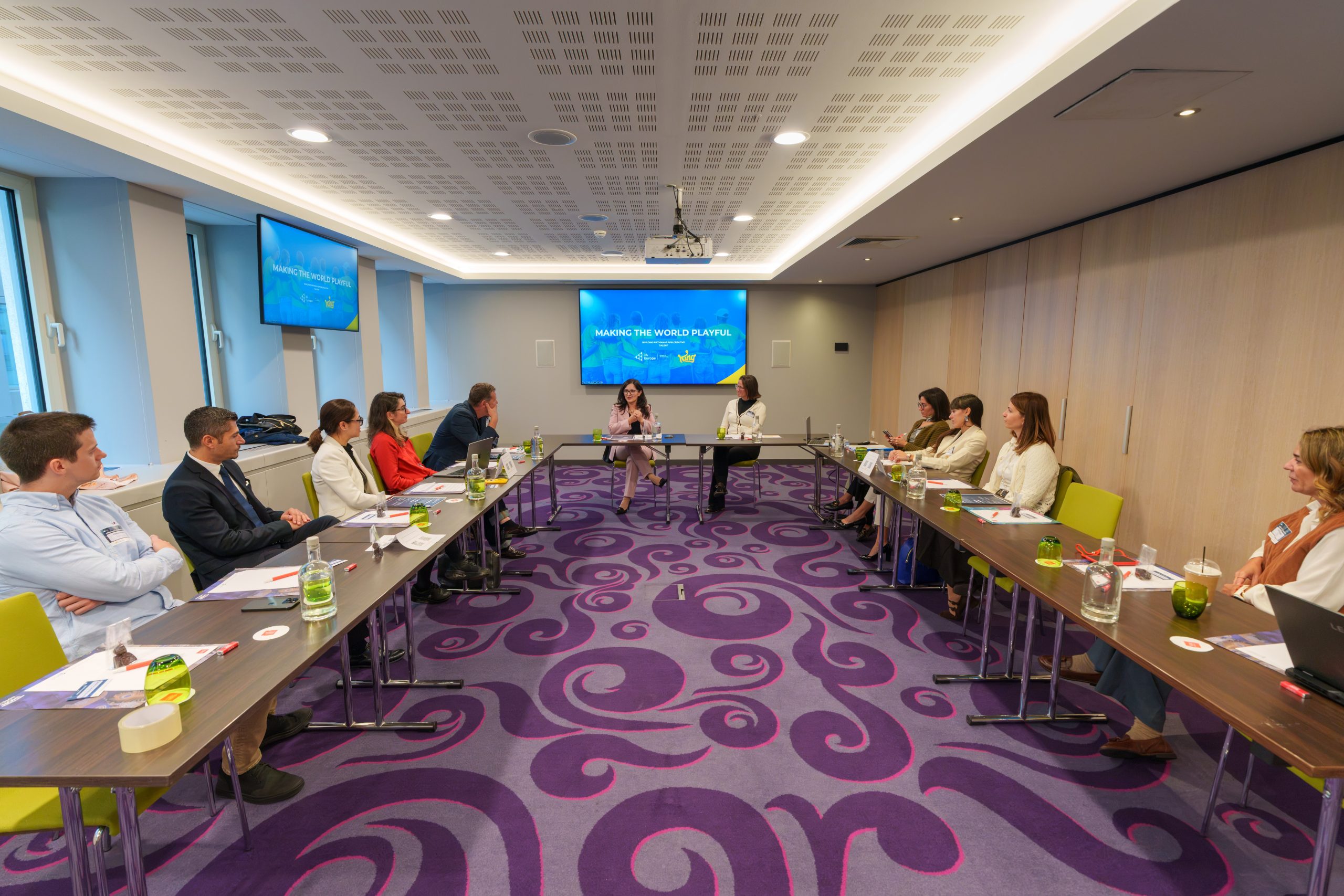
Industry, EU policymakers and education partners came together at JA Europe’s forum in Brussels to explore how hands-on experience of the games industry can help young people recognise their skills and see where they can lead.
BRUSSELS, 14 October 2026 — At JA Europe’s forum From Skills to Opportunity, the roundtable Making the World Playful: Building Pathways for Creative Talent put the King–JA Europe partnership in the spotlight. Since it began, the partnership has engaged more than 400 students through practical workshops, hackathons and work-experience opportunities.
Moderated by Diana Filip, Deputy CEO and Chief Development Officer at JA Europe, the discussion featured Vikki Leach, Senior Director of Diversity, Equity and Inclusion at King, alongside contributors from 28DIGITAL, Video Games Europe, Turing College, DG EMPL and DG EAC. In her opening speech, Vikki Leach shared how giving young people the opportunity to test their skills through real-world game-development challenges and workplace experience can create clearer pathways into STEAM, technology and video games careers.
“Mobile games sit at the intersection of creativity and technology, combining creative thinking and technical problem-solving. That makes our sector a useful example of the multidisciplinary skills Europe increasingly needs. Our strong partnership with JA Europe helps give young people practical exposure to real-world challenges and workplaces early on. We help make the range of careers behind games more visible and tangible, while equipping them with the skills and confidence for their future careers.”
— Vikki Leach, Senior Director of Diversity, Equity and Inclusion, King
King’s Mobile Matters: The Impact of Mobile Games for Europe report explores video games’ contribution to Europe’s economy, creativity and digital skills. As part of that research, a survey of more than 1,500 young people aged 16–21 in the UK, Spain and Sweden, carried out with JA Europe’s support, found that 48% play mobile games daily and 84% weekly. Weekly players were more likely to feel confident using advanced digital skills, solving technical problems and working with data.
Yet careers in games remain hard to see from the outside, and many young people assume that everyone behind a game is a coder. Video Games Europe cited a recent mapping by the French games trade association showing that only 31% of people working in the industry are in technical roles such as programming, while 46% work in arts disciplines, from visual design to sound and music.
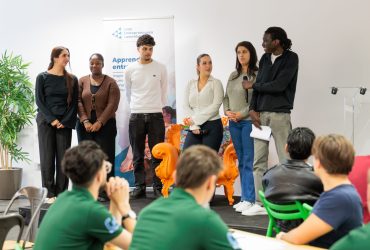
King brings that range to life through hackathons, where around 50 students spend a day in a King office working in teams on a brief — most recently, to design a game that champions sustainability and plan how to market it to players — with support from King employee volunteers. Winning teams earn work experience, and around 25 students have so far spent time inside King’s offices across Europe, meeting teams in game design, programming, development and marketing. Participants highlighted the interactive format and the chance to practise their presentation skills.
Leach described the shared principle behind King’s partnerships as “a focus on practical exposure, real connections to employees and as clear a route as possible into opportunity.” Demand for real work experience is high, she said, but access remains a barrier for young people without existing networks, and even a single day in industry can enrich a CV and build the belief that a career in games is possible. King tracks participation and collects feedback to show its impact and improve the programmes, and quality takes commitment, from a full day of staff time to a dedicated group of volunteers. Opening access is what drives the work: “I truly believe talent is everywhere, but access to opportunity isn’t,” Leach said.
The conversation then turned to what it takes to scale these pathways. Video Games Europe noted that the sector competes for talent with big tech and needs a stronger skills pipeline in Europe, pointing to Romania’s optional high-school games curriculum, co-developed by government and industry, and to a handbook for teachers on using video games in the classroom, now available in eight languages. The founder of Turing College, himself a JA alumnus, observed that AI tools now let any student prototype a game in minutes, which makes equal access to those tools an inclusion question. 28DIGITAL stressed that creativity and teamwork grow when young people are given real challenges to solve together.
From the European Commission, DG EMPL pointed to Union of Skills tools such as Pacts for Skills and the EU Skills Academies, both of which have begun using game-based training to attract people into sectors. DG EAC highlighted the STEM Education Strategic Plan and noted that partnerships between business and schools also need supporting structures and policy, beyond the goodwill of those involved, to be sustainable.
Participants also looked at how the King–JA Europe model works in practice. King works through NGO partners with reach into schools and communities rather than approaching schools directly. JA Europe’s national members work with ministries of education and assess which schools have the capacity to take part, and King shares its early-careers and social impact strategies so that activities match its ambitions — which sometimes means saying no.
The roundtable was one of several sessions at the forum, which brought together over 120 participants in Brussels and 230 online and featured collaborations with private-sector partners King, NN Group and UPS. Its message echoed a challenge that ran through the whole programme: Europe must not only help young people develop skills, but also make those skills visible, recognised and relevant to opportunities in the labour market and beyond.
About JA Europe
JA Europe is a leading European organisation dedicated to inspiring and preparing young people to succeed. For over 100 years, JA Worldwide has delivered hands-on, experiential learning in entrepreneurship, work readiness and financial health. In the 2024–2025 school year, the JA Europe network, active in more than 40 countries, provided over 7.5 million learning experiences, alongside more than 95,000 teaching experiences and 86,000 volunteering and mentoring experiences.
About King
King, the creator of Candy Crush, is a leading mobile games company founded in Sweden, with locations in Germany, Spain, Sweden and the UK. Guided by its mission of making the world playful, King’s games are played by hundreds of millions of people around the world.
Media contact
Irina Ilieva, Head of Marketing, Communications and Policy, JA Europe — irina@jaeurope.org