


From Skills to Opportunity | 14 October 2026 | Brussels and online
European policymakers, business leaders and educators explored how employability micro-credentials, creative learning and digital innovation can help young people turn their skills into opportunities and strengthen Europe’s competitiveness.
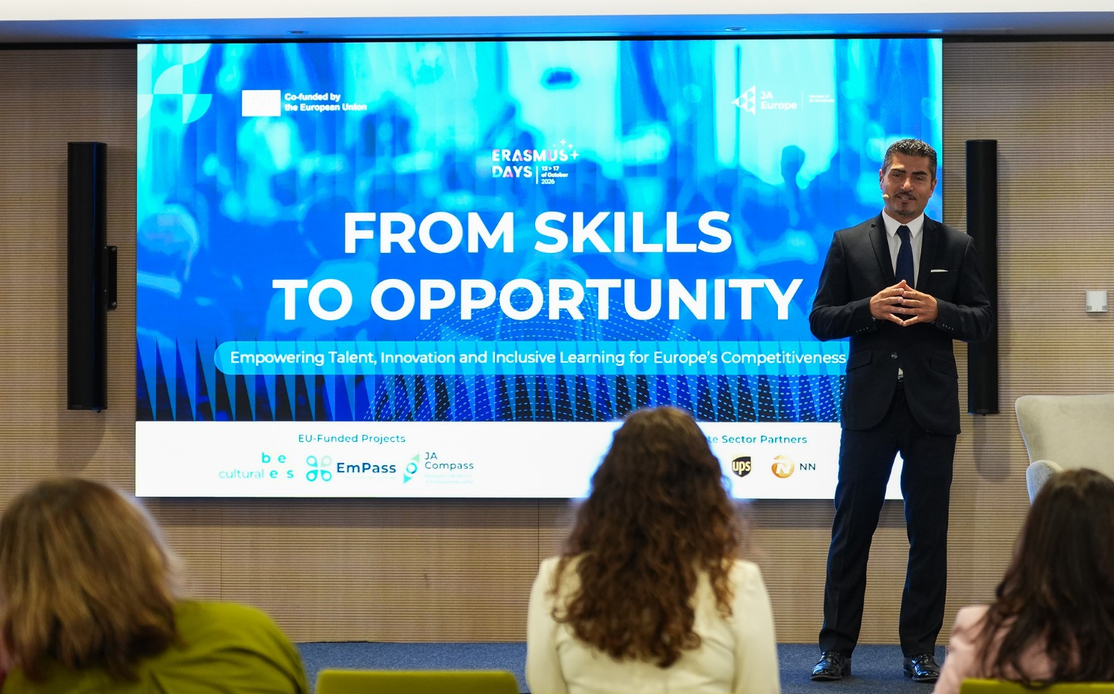
BRUSSELS, 14 October 2026 — “Talent is everywhere in Europe, opportunity is not.” With this message, Victor Negrescu, Vice-President of the European Parliament and Co-Chair of the Intergroup on the Future of Education and Skills for a Competitive Europe, addressed JA Europe’s forum From Skills to Opportunity: Empowering Talent, Innovation and Inclusive Learning for Europe’s Competitiveness in Brussels in a video message.
Negrescu called for at least 20% of the EU’s 2028–2034 long-term budget to support education and skills and for European funding to reach those who need it most, including young people in rural communities and disadvantaged regions. “We cannot claim to promote equal opportunities while reducing the European resources that make them possible,” he said. He also urged that success be measured not by the number of participants in European programmes, but by how many young people find quality jobs, start businesses and improve their lives.
In a video address to the forum, Roxana Mînzatu, Executive Vice-President of the European Commission for Social Rights and Skills, Quality Jobs and Preparedness, underlined the importance of connecting skills with real opportunities: “Competitiveness is not just about having the right skills, it is also about giving people the chance to put those skills to work. And this is how we turn talent into opportunity and opportunity into progress for Europe.”
The forum brought together over 120 participants in Brussels and 230 online— policymakers, employers, educators, innovators and project partners — to explore how Europe can better develop, recognise and connect skills with education, employment and entrepreneurship. It featured three EU co-funded projects — EMPASS (Erasmus+), Cultural BEES (Creative Europe) and Game4Change (Erasmus+) — alongside collaborations with private-sector partners King, NN Group and UPS.
Salvatore Nigro, CEO of JA Europe, set the tone with a simple message: “We cannot define talent by a zip code. We cannot fail. Today, we have all the right ingredients to make sure that we recognise those skills, unleash those skills, and leave with a suitcase of skills that we want to bring back to our respective countries.”
The Employment Skills Pass (EMPASS) project, co-funded by the EU’s Erasmus+ programme (Forward-Looking Projects), addresses a central labour-market challenge: how can young people demonstrate their readiness for work beyond traditional qualifications?
EMPASS is developing an employability micro-credential assessing 11 essential skills, including communication, teamwork, problem-solving and resilience. It was designed to be piloted with 1,500 students in Greece, Romania and Spain, and, according to the project’s latest monitoring figures,2700 young people now hold an EmPass certificate.
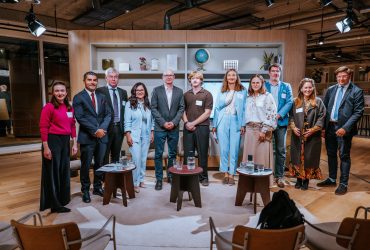
The flagship panel, Skills, Mobility and Innovation for Europe’s Competitiveness, examined how employability skills can become more visible, trusted and recognised across education, employment and policy systems. Moderated by Diana Filip, Deputy CEO and Chief Development Officer at JA Europe, it brought together Mario Nava (Director-General, European Commission’s DG EMPL), Minna Melleri (Executive Director, World Employment Confederation), Giulia Meschino (Director-Secretary General, European Vocational Training Association) and Jasper Van Loo (Department coordinator for skills and labour market, Cedefop).
“Businesses are hungry and thirsty for skills. They understand that skills are what is needed to innovate and to remain competitive.”
Mario Nava, Director-General for Employment, Social Affairs and Inclusion, European Commission
Cultural BEES, co-funded by the EU’s Creative Europe programme (Cooperation Projects), supports young people aged 15–30 in developing skills and opportunities in the cultural and creative industries. Two sessions explored how skills gained through creative practice, cultural participation and entrepreneurship can be made visible and transferable across learning and employment pathways.
Recognising Skills in the Cultural and Creative Sectors: From Practice to Policy, moderated by Paolo Montemurro (Director and Co-founder, Materahub), featured Barbara Stacher (European Commission’s DG EAC), Dr Rolf Hughes (EIT Culture & Creativity), Stavros V. Kyriakides (Kyriakides Piano Gallery) and Dr Ruba Saleh (ICHEC Brussels Management School).
“Building trust in skills requires collaboration between policymakers, educators, employers and the cultural and creative sectors.” “When skills become visible and portable, opportunities become more accessible for everyone.” –Barbara Stacher
From Evidence to Action: Implementing Skills Recognition in CCSI looked at what is needed to sustain and scale skills-recognition approaches in the cultural and creative sectors. Moderated by Dr Antigoni Komodiki (CEO of JA Cyprus and Chairwoman of the Board of Executives of JA Europe), it featured Dilyana Gyurova (JA Bulgaria), Francesca Mazzieri (JA Italy), Matteo Luigi Bianchi (ANCI Lombardia) and Paolo Montemurro.
“The programme showed that when young people are given the right tools, creativity multiplies.” Dr Antigoni Komodiki
“We no longer have the possibility to work alone if we want to generate impact and ensure sustainability. The next step is to take what we have tested at European level, open it to local stakeholders and adapt it to each local cultural and creative ecosystem.” — Paolo Montemurro
Developed through the Game4Change project, co-funded by the EU’s Erasmus+ programme, JA Compass uses gamification and interactive learning to make entrepreneurship education more engaging and accessible.
Beyond Screen Time: Digital Learning, Entrepreneurial Mindsets and the Future of Skills, moderated by Irina Ilieva (Head of Marketing, Communications and Policy, JA Europe), explored how technology can strengthen the human and entrepreneurial dimensions of learning. It brought together Brikena Xhomaqi (Lifelong Learning Platform), Prof Bart Derre (HOGENT University and VUB), Adrian Duşa (European Commission’s DG EAC) and Giuseppe Bucca (Istituto Tecnico Tecnologico Ettore Majorana).
“The question is no longer how to become more digital in education, but how to become better digital. The goal is to create learning experiences that are youth-driven, relevant to the times we live in, and meaningful for young people.” – Adrian Duşa
From Engagement to Impact: Scaling JA Compass Through EU Funding, Business Partnerships and Youth Uptake, moderated by Joanna Andrzejewska (Head of Programmes, JA Europe), considered what it would take to grow the platform to one million young people across Europe. The panel featured Manel Sanchez (EYCA), Per Strömbäck (Swedish Games Industry), Juan Simoes Iglesias (YMCA Europe), Ivana Davidovska (Disability Support Europe) and Tomas Moška (Turing College).
“The focus is not on banning technology. It is about enabling young people to become active users who understand, master and engage with technology, while knowing when to use it and, even more importantly, when not to use it.” – Manel Sánchez
“We cannot fix something if we do not address its root causes. The key is to nurture curiosity from the earliest years and help people see learning as a lifelong journey, not something that happens only in classrooms.” – Tomas Moška
Alongside the EU-funded projects, the forum was supported by private-sector partners King, NN Group and UPS, whose collaborations with JA Europe show how business can help translate skills development into practical opportunities for young people.
The roundtable Making the World Playful: Building Pathways for Creative Talent showcased the King–JA Europe partnership, which has engaged more than 400 students through practical workshops, hackathons and work-experience opportunities. Vikki Leach, Senior Director of Diversity, Equity and Inclusion, shared how giving young people the opportunity to test their skills through real-world game-development challenges and workplace experience can create clearer pathways into STEAM, technology and video games careers. Moderated by Diana Filip, the discussion also featured contributors from 28DIGITAL, Video Games Europe, Turing College, DG EMPL and DG EAC.
Vikki Leach, Senior Director of Diversity, Equity and Inclusion at King, said: “Mobile games sit at the intersection of creativity and technology, combining creative thinking and technical problem-solving. That makes our sector a useful example of the multidisciplinary skills Europe increasingly needs. Our strong partnership with JA Europe helps give young people practical exposure to real-world challenges and workplaces early on, we help make the range of careers behind games more visible and tangible, while equipping them with the skills and confidence for their future careers.”
The invitation-only roundtable Economic Opportunities for All: Business, Skills and Inclusion in Europe, moderated by Salvatore Nigro, examined how business, education and civil society can work together to open pathways for young people. It featured Lonneke Roza, Head of Community Investment at NN Group, and contributors from UNESCO, EuroCommerce, WindEurope, EVTA, the European Federation of Education Employers, the Lifelong Learning Platform, EACEA, JA Europe and JA Ukraine. In his address to the forum, Negrescu congratulated JA Europe and its partners on the Economic Opportunities for All initiative, citing more than 90,000 learning experiences across 10 countries
“Our partnership with JA Europe has shown us the value of building a relationship around a shared social ambition, with the trust and flexibility to evolve over time. If we want successful initiatives to reach more young people, we need to look beyond project funding and invest in the capacity of organisations to grow, adapt and create lasting impact. Companies can bring resources, expertise and employee volunteers, but real change happens when we learn from each other and work together.” -Lonneke Roza, Head of Community Investment, NN Group.
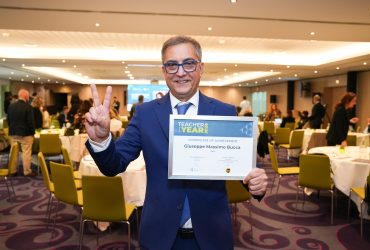
The programme closed with the JA Europe Teacher Award, powered by UPS, recognising educators who help young people build entrepreneurial mindsets. The award was presented by Chelsea Allison, Vice President of Human Resources at UPS EMEA, to Giuseppe Bucca, Teacher, Istituto Tecnico Tecnologico Ettore Majorana.
“A great teacher does far more than deliver lessons. They help students find confidence when they doubt themselves, and they encourage curiosity when the answer isn’t obvious. At UPS, we believe that economic opportunity begins with education.” Pointed out Chelsea Allison.
“When students stop waiting for my help and solve problems together, that is success. In these 10 years, I have seen many business plans, many prototypes and listened to many pitches. But most of all, I’ve seen my students and colleagues turn dreams into reality. Maybe this award is one of those dreams too.” Giuseppe Bucca, Teacher, Istituto Tecnico Tecnologico Ettore Majorana
Across the programme, From Skills to Opportunity highlighted a shared challenge: Europe must not only help young people develop skills, but also make those skills visible, recognised and relevant to opportunities in the labour market and beyond.
EMPASS (Erasmus+ Forward-Looking Projects), Cultural BEES (Creative Europe Cooperation Projects) and Game4Change, which developed JA Compass (Erasmus+), demonstrate complementary approaches — from employability micro-credentials and recognition of skills developed through creative practice to interactive digital entrepreneurship education. The discussions also underlined the importance of sustained collaboration between policymakers, employers, educators, civil society and business.
The discussions highlighted three key priorities: strengthening skills recognition across education and employment, promoting inclusive and meaningful learning, and fostering collaboration between policymakers, educators and employers.
Through initiatives such as EmPass, Cultural BEES and Game4Change, JA Europe and its partners continue working to turn these priorities into action, ensuring that young people’s skills translate into real opportunities.
About JA Europe
JA Europe is a leading European organisation dedicated to inspiring and preparing young people to succeed. For over 100 years, JA Worldwide has delivered hands-on, experiential learning in entrepreneurship, work readiness and financial health. In the 2024–2025 school year, the JA Europe network, active in more than 40 countries, provided over 7.5 million learning experiences, alongside more than 95,000 teaching experiences and 86,000 volunteering and mentoring experiences.
Co-funded by the European Union. Views and opinions expressed are those of the author(s) only and do not necessarily reflect those of the European Union or the European Education and Culture Executive Agency (EACEA). Neither the European Union nor EACEA can be held responsible for them.
Media contact
Irina Ilieva
Head of Marketing, Communications and Policy
irina@jaeurope.org