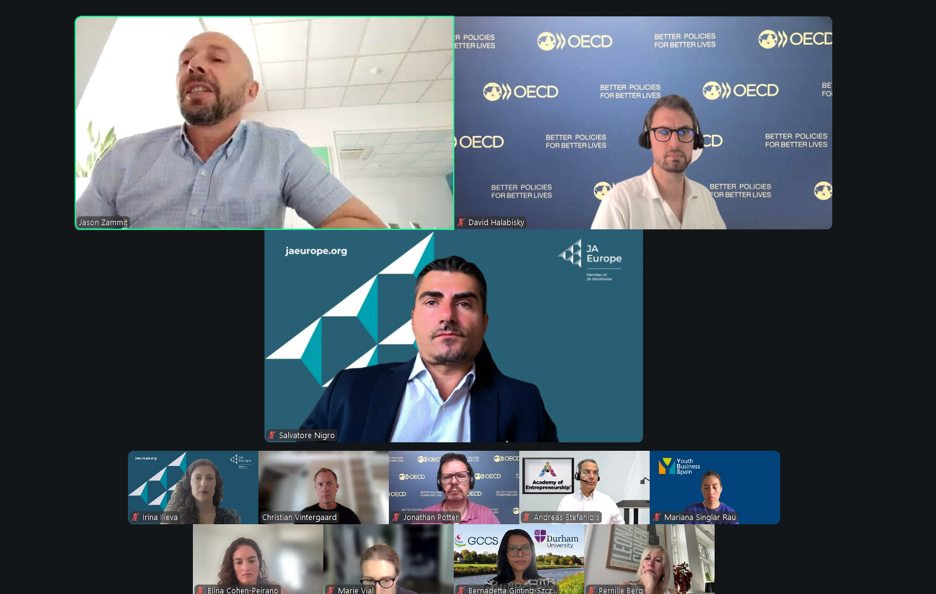



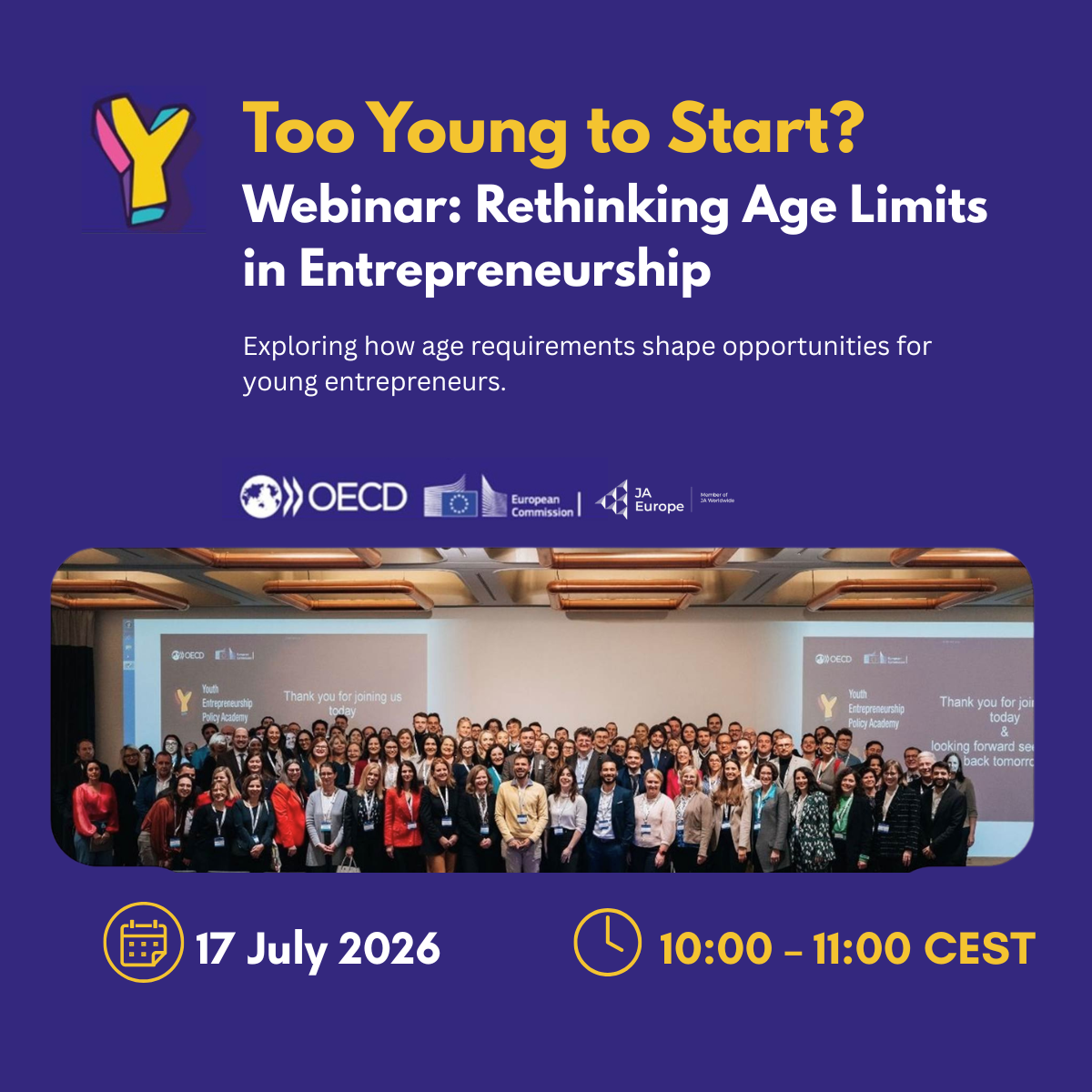
Brussels, July 2026 – How can Europe ensure that young people with entrepreneurial talent are not prevented from turning their ideas into real businesses? This question brought together policymakers, entrepreneurship organisations and ecosystem leaders from across Europe for the latest webinar of the OECD-EU Youth Entrepreneurship Policy Academy (YEPA),“Too Young to Start? Rethinking Age Limits in Entrepreneurship.”
Hosted by the OECD and the European Commission in partnership with JA Europe, the webinar explored how policy can support young people in moving from entrepreneurial learning to entrepreneurial action, drawing on experiences from Malta and Denmark.
Opening the session, David Halabisky, Project Coordinator for Inclusive and Sustainable Entrepreneurship at the OECD, welcomed participants from across the YEPA community. Representatives of the European Commission highlighted the Academy’s ambition to strengthen youth entrepreneurship policies through collaboration, peer learning and the exchange of practices across Europe.
Representing JA Europe, Salvatore Nigro, CEO of JA Europe, framed the discussion within the broader context of Europe’s competitiveness, innovation and startup agenda.
Drawing on JA Europe’s experience of equipping 7.5 million young people with entrepreneurial competences each year and supporting more than 400,000 students in creating and running real businesses through entrepreneurship programmes, he highlighted the significant entrepreneurial potential that already exists among Europe’s youth. Referring to**#GEN_E**, Europe’s largest entrepreneurship festival, Salvatore stressed that Europe does not suffer from a shortage of entrepreneurial talent. Instead, too many promising ventures face obstacles when attempting to transition from education into the real economy.
He also connected the discussion to the European debate around EU Inc. and the proposed 28th Regime, noting that if Europe wants innovative entrepreneurs to think and operate across borders from the earliest stages of their journey, simplification should begin long before companies become scaleups.
The webinar then turned to two national case studies illustrating different approaches to supporting young entrepreneurs.
Jason Zammit, representing the Malta Youth Agency, presented Malta’s new legislative framework allowing 16-year-olds to register a business. Beyond the legal change itself, he outlined a comprehensive support model including mentoring, entrepreneurship training, youth worker involvement and continuous guidance for young entrepreneurs.
His presentation highlighted that legislative reform is only one part of the solution. Malta’s approach combines greater opportunities for young people with safeguards designed to help them navigate the responsibilities of business ownership. Throughout the discussion, Jason also recognised the contribution of JA Malta and the wider entrepreneurship ecosystem in helping young people develop entrepreneurial ambitions and transform ideas into viable ventures.
Providing a complementary perspective, Christian Vintergaard, CEO of Denmark’s Foundation for Entrepreneurship (FFE), shared insights into Denmark’s long-term commitment to entrepreneurship education. He explained how entrepreneurship has been embedded throughout the educational journey, helping young people develop the confidence, skills and mindset needed to create, change and make a difference. Christian also demonstrated how evidence gathered through entrepreneurship education programmes is increasingly being used to inform national policy discussions and support the development of future entrepreneurship initiatives.
The discussion that followed brought together YEPA participants from across the European Union and explored a range of topics, including the role of parents in supporting young entrepreneurs, government frameworks, access to funding, mentorship opportunities and the importance of coordinated ecosystem support.
A clear message emerged from both the Danish and Maltese experiences: legislation can open doors, but ecosystems help young people walk through them. Entrepreneurship education, mentoring, access to finance, supportive public policies, engaged families and strong partnerships all play a critical role in helping entrepreneurial potential become entrepreneurial success.
As Europe continues to seek ways to strengthen its competitiveness, innovation and startup ecosystem, the discussion reinforced the importance of creating seamless pathways that allow young people to transform classroom ideas into businesses capable of creating economic and social value across Europe.
About the OECD-EU Youth Entrepreneurship Policy Academy (YEPA)
The OECD-EU Youth Entrepreneurship Policy Academy (YEPA) is a peer-learning network established by the European Commission and the OECD to strengthen youth entrepreneurship policies across Europe. Bringing together policymakers, entrepreneurship organisations, researchers and young entrepreneurs, YEPA supports knowledge exchange and the development of evidence-based approaches that help young people overcome barriers to entrepreneurship and business creation.
About JA Europe
JA Europe is the largest and leading organisation in Europe dedicated to inspiring and preparing young people to succeed. For over 100 years, JA Worldwide has delivered hands-on, experiential learning in entrepreneurship, work readiness and financial health. In the last school year, the JA Europe network, active in over 40 countries, provided more than 7.5 million learning experiences for youth in online, in-person and blended formats, and delivered over 95,000 teaching experiences and 86,000 volunteering and mentoring experiences. Media Contact: Irina Ilieva Head of Communications, Marketing and Policy, JA Europe irina@jaeurope.org