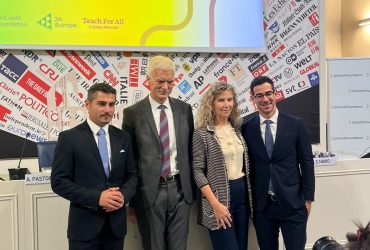



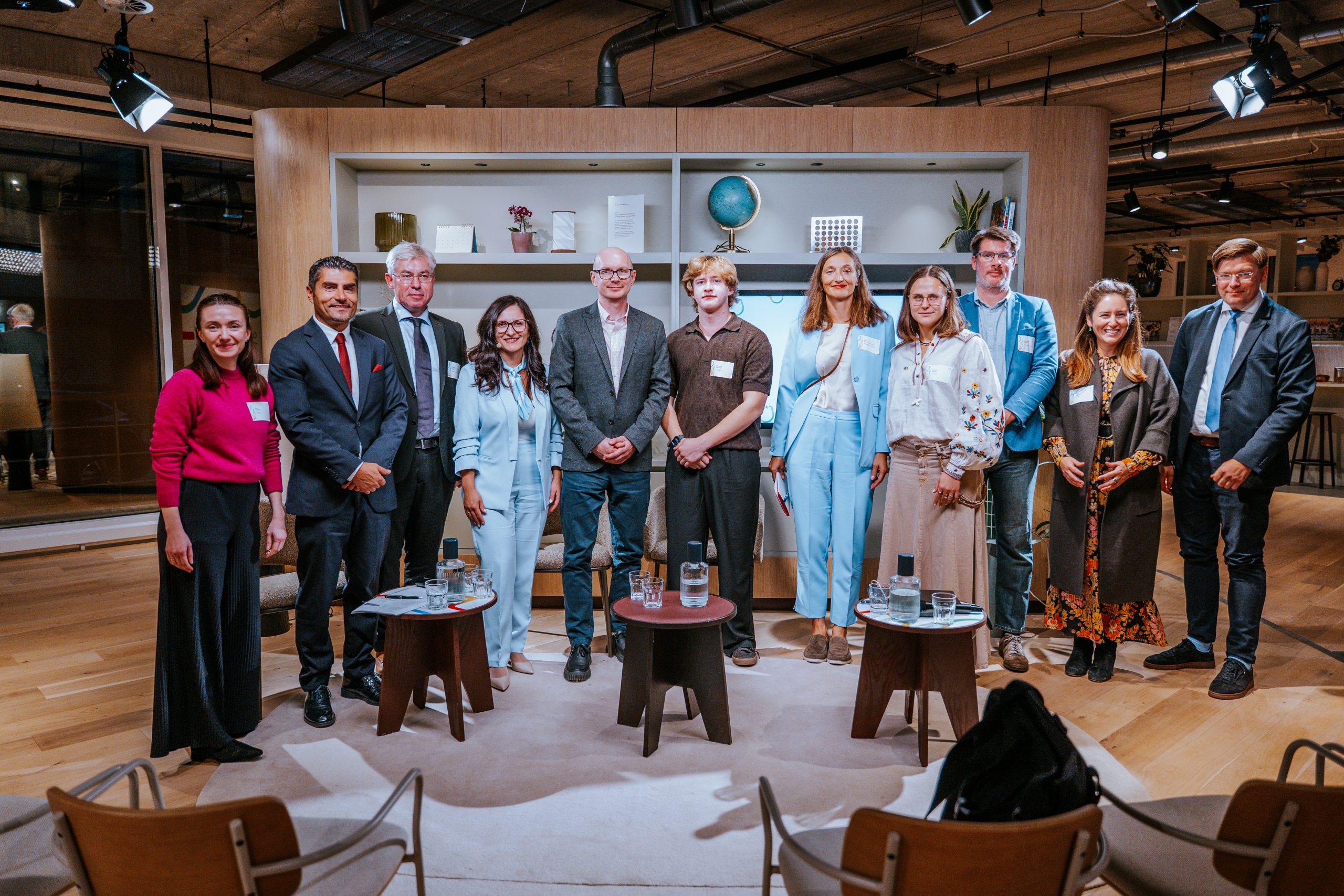
On 22 September, JA Europe opened the first youth-focused event at Connected Cup, a temporary AI pop-up hosted by Google Europe and BUMP in Brussels. The event brought together Ukrainian educators and young innovators with representatives of the Mission of Ukraine to the EU, the European Parliament, the European Commission and Google.org.
At the centre of the conversation were two voices from Lviv: a teacher and a student. Their contributions moved beyond abstract discussions about what AI might mean for education in the future. Instead, they showed how artificial intelligence is already being used to support learning, entrepreneurship and problem-solving in Ukraine, a country continuing its digital transformation under extraordinarily difficult circumstances.
Learning and building under pressure
Roman Babyuk, a teacher at Higher Vocational School No. 29 in Lviv, has redesigned his entrepreneurship classes around AI. He shared insights into what is already working in Ukrainian classrooms and how educators can use technology to keep students curious, motivated and focused on creating practical solutions.
Oleksandr Havryliuk, a robotics student at Ukrainian Catholic University, offered the perspective of a young innovator. Over the past year, he has been developing an AI-powered sensor that helps people with hearing loss recognise environmental sounds through a mobile application.
Roman and Oleksandr demonstrated how education and innovation can be connected to real-world needs. Their experiences also highlighted what it takes to teach, learn and build with emerging technologies during wartime.

From digital services to future skills
The discussion began with opening remarks from Oleksii Selin, Deputy Head of Ukraine’s Mission to the EU, and Levente Császi of the European Parliament’s Directorate-General for Parliamentary Research Services.
Haviva Kohl of Google.org then broadened the conversation by discussing the reach of the AI Opportunity Fund and the lessons Google’s team has gained from delivering AI training at scale. She also explored Google’s contribution to Ukraine’s vision of a digital-first nation, including digital services and platforms such as Diia, Mriia and Obrii, a new AI-powered labour market platform.
Elena Višnar Malinovská of the European Commission’s Directorate-General for Enlargement and Eastern Neighbourhood discussed the role of education, skills and employment in Ukraine’s reconstruction and accession process. She also outlined how the European Union is supporting skills development for Ukrainians on the ground.

Young voices in the AI debate
The event reinforced the importance of involving young people and educators in conversations about AI. They are not only future users of these technologies. They are already developing solutions, adapting learning environments and identifying the challenges that policymakers and technology companies need to understand.
Ukraine’s experience offers valuable lessons for Europe. Digital transformation does not happen only in ideal conditions. It can also emerge through uncertainty, limited resources and urgent social needs. In such circumstances, education and technology become closely connected to resilience, opportunity and recovery.

Continuing the conversation
Thank you to all the speakers and contributors who made the event possible.
Special thanks go to Yuriy Tokarski, CEO of JA Ukraine, for building and sustaining meaningful programmes on the ground; Diana Filip, Deputy CEO of JA Europe, who moderated the discussion; and Elena Tosheva, Senior Manager, EMEA Brand and Reputation Marketing at Google, whose idea created the space for these conversations.
Two further Connected Cup sessions will take place in October:
12 October: From AI in Today’s Classroom to the School of Tomorrow, bringing together secondary students and teachers.
14 October: From Real-World Problems to AI-Powered Solutions, an interactive workshop for university students, freelancers, young professionals and AI start-up teams.
The conversation about AI and Europe’s future must include the people who will study with it, work with it and build with it. Ukraine’s educators and young innovators are already showing why their experiences belong at the centre of that conversation